
NDIS Billing Software Australia: Complete Guide for Providers in 2026
Discover how NDIS billing software Australia can help providers streamline invoicing, manage bulk claims, reduce billing errors and connect rostering, attendance and service records. This 2026 guide explains key features, billing workflows, pricing considerations and what Australian NDIS providers should look for when choosing the right software.
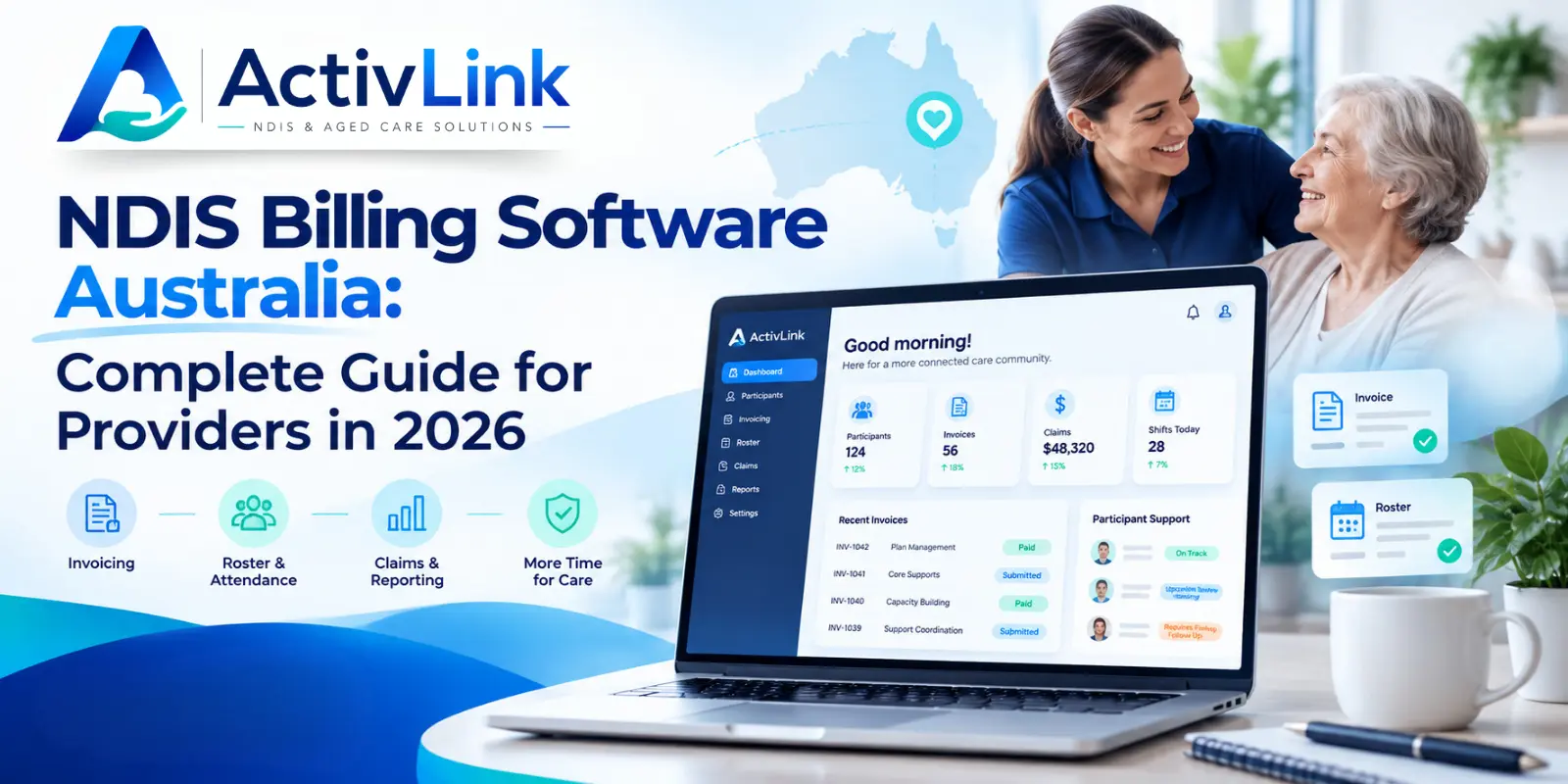
For Australian disability service organisations, accurate billing is closely connected with rosters, attendance, participant records, service agreements and delivered supports. NDIS billing software Australia providers choose should therefore do more than create invoices. It should help connect operational information, so authorised teams can review services, prepare billing and reduce unnecessary double handling. For organisations managing multiple care programs, suitable NDIS and aged care software can also create a more consistent operational foundation across workforce and client administration.
What Is NDIS Billing Software Australia?
NDIS billing software Australia is software designed to help NDIS providers organise information used for invoicing, payment requests and financial administration. Depending on the platform, it may connect participant details, service agreements, support items, attendance records, approved shifts, invoice generation and reporting.
Rather than rebuilding billing information from spreadsheets, emails and paper timesheets, providers can work from structured service records. The goal is not simply faster invoicing. It is clearer traceability between what was scheduled, what was delivered, what was approved and what is ready to bill.
For growing providers, this connected approach can reduce repeated data entry and give finance, administration and operations teams a shared view of billing-related information.
Why Is NDIS Billing Software Important for Australian Providers in 2026?
Billing under the NDIS requires accurate service information, appropriate support items, correct prices and records that align with the participant's funding arrangement. In 2026, providers also need to stay aware of current NDIS pricing guidance and claiming processes. For this reason, NDIS billing software Australia should be assessed against current provider workflows rather than outdated billing assumptions.
The NDIS pricing schedule effective from 1 July 2026 includes support item numbers, support item names, units and national, remote and very remote recommended maximum prices. Because pricing information can change, NDIS billing software Australia providers use should make it easier to maintain current service items and review invoice details before submission.
At the same time, billing is rarely an isolated task. A missed clock-out, an incorrect service duration or an outdated service agreement can create extra work later. Consequently, providers benefit when workforce operations and billing information are connected.
How Does NDIS Billing Software Work?
In practical terms, NDIS billing software in Australia should help move service information through a controlled workflow.
A typical process may look like this:
- A participant's service agreement and relevant support items are recorded.
- A worker is rostered to deliver the service.
- Attendance or service delivery is recorded.
- An authorised team member reviews or approves the service record.
- Approved information becomes available for invoice preparation.
- The invoice or claim information is reviewed before the next payment step.
- Billing records are retained for reporting and follow-up.
The exact workflow differs between software platforms and provider models. However, the key principle is consistency: billing should be based on reliable service information rather than re-entered data wherever possible.
Connecting Rostering, Attendance and Billing
This is where NDIS billing software Australia can become more valuable than a standalone invoicing tool. When rostering, attendance and billing sit in separate systems, administrators may need to compare multiple records before an invoice can be prepared.
A connected care workforce platform can reduce that fragmentation. For example, an approved attendance record can support invoice preparation while maintaining a clearer link back to the worker, participant, date and delivered service.
That does not remove the need for review. Instead, it gives authorised staff better information to review.
What Information Is Needed for NDIS Payment Requests?
According to current NDIA guidance, providers making a payment request need information including the participant name, participant reference number or NDIS number, dates of support, support item reference number and support item price.
Payment arrangements also differ according to how the participant's funding is managed. Self-managed participants receive invoices directly, plan-managed participants generally have invoices sent to their plan manager, while NDIA-managed supports involve payment requests through the relevant provider process.
Therefore, NDIS billing software Australia should help providers keep participant, service and billing information organised while allowing staff to follow the correct process for each funding arrangement.
Self-Managed, Plan-Managed and NDIA-Managed Billing
A useful billing system should make it easy to identify the relevant participant and funding context before an invoice or payment request is prepared.
For self-managed participants, providers generally invoice the participant. For plan-managed participants, invoices are sent to the plan manager. For NDIA-managed participants, registered providers submit payment requests through the applicable NDIS provider process.
Because these pathways are not identical, providers should avoid treating every invoice as if it follows the same administrative workflow.
What Are NDIS Bulk Claims?
Bulk claiming allows providers to submit multiple payment requests together rather than processing each one individually. Current NDIA guidance states that bulk payment requests can be made through the bulk payment request upload process and are required for supports delivered to participants with plans in the newer NDIS computer system.
For organisations managing a high volume of services, NDIS billing software Australia can help by organising billing-ready records before information is prepared for a bulk process. Well-configured NDIS billing software Australia can also make exceptions easier to identify before a large batch is finalised.
The benefit is operational efficiency. However, bulk processing also makes data quality important because incorrect dates, prices, support items or management details can create rejected claims and additional administrative work.
Why Are NDIS Claims Rejected?
A rejected claim creates more than a payment delay. It can lead to investigation, correction, resubmission and additional communication between operational and finance teams.
NDIA guidance notes that claims may be rejected when information such as the date, price or fund-management type is incorrect. Providers therefore need reliable processes for checking service and billing information before submission.
NDIS billing software Australia cannot guarantee that every claim will be accepted. However, software can support a more structured review process by keeping service details, participant information and invoice records in one place. In practice, NDIS billing software Australia is most useful when it supports disciplined checking rather than replacing it.
How Can Providers Reduce Billing Errors?
Providers can reduce preventable billing errors by building clear approval steps into their workflow.
Useful practices include:
- keeping service agreements and support items current;
- confirming worker attendance and service duration;
- reviewing participant and funding information;
- checking the applicable support item and price;
- avoiding duplicate invoice creation;
- investigating missing or inconsistent service records;
- maintaining clear approval responsibilities; and
- reviewing billing exceptions before claims are submitted.
When NDIS billing software Australia supports these steps within the wider care workflow, administrators have less need to reconstruct what happened from disconnected files.
What Features Should NDIS Billing Software Include?
Choosing software should start with the provider's actual workflow rather than a long feature list. The most useful platform is one that supports the organisation's service model, team size, billing volume and internal controls.
For many Australian providers, important capabilities include participant records, service agreements, support-item management, price-aware invoicing, bulk invoice generation, attendance records, approval workflows, permissions, audit histories and reporting. A strong NDIS billing software Australia solution should connect these functions in a way that matches real provider processes.
NDIS billing software Australia should also be easy enough for coordinators and administrators to use consistently. Complicated systems can simply move administrative problems into another platform.
NDIS Price-Aware Invoicing
Price-aware invoicing can help administrators work with current service items and rates while preparing invoices. In 2026, providers should refer to the current NDIS pricing schedule and 2026–27 NDIS Support Catalogue when checking relevant prices and claiming information.
Software should support this work without suggesting that automation replaces provider responsibility. Rates, agreements, delivered supports and claim details still need appropriate oversight. Therefore, NDIS billing software Australia should make review easier as well as invoice generation faster.
Bulk Invoice Generation
Bulk invoice generation can be particularly useful for providers managing many participants or repeated services. Instead of building invoices one by one, authorised staff can prepare multiple invoices from reviewed service records.
The strongest NDIS billing software workflows in Australia still include checks before invoices move to the next stage. Speed is useful only when the underlying information is accurate.
Roles, Permissions and Audit Trails
Billing data can include sensitive participant and business information. Therefore, providers should consider who can view, create, edit, approve and export billing records.
Role-based permissions can help separate responsibilities, while audit histories provide visibility over changes. These controls also make it easier to investigate an error or understand how a billing record was updated.
Can NDIS Billing Software Save Providers Time?
Yes. When the software reduces unnecessary re-entry and brings related operational information together, it can make everyday administration more efficient.
For example, if a coordinator creates a shift, a support worker records attendance and an administrator later prepares an invoice, those actions should ideally form part of a connected process. When each team maintains separate spreadsheets, staff may spend valuable time checking dates, hours and participant details repeatedly.
NDIS billing software Australia can help streamline those hand-offs. In this context, NDIS billing software Australia works best when teams use consistent approval and recordkeeping processes. The time saving comes from better information flow, not simply from generating an invoice faster.
Is NDIS Billing Software Suitable for Small Providers?
Small NDIS providers can benefit from billing software, particularly when spreadsheets begin to create duplicated work or make records difficult to follow. NDIS billing software Australia can be relevant well before a provider reaches enterprise scale.
However, smaller organisations should avoid buying unnecessary complexity. Look for software that supports the workflows you use now while giving the business room to grow.
When assessing NDIS billing software Australia for a small provider, consider ease of setup, staff limits, participant limits, rostering and attendance features, invoice capabilities, support, reporting and future scalability.
A platform that combines workforce and billing workflows may also reduce the number of separate subscriptions and data sources the team needs to maintain.
What Is the Difference Between NDIS Billing Software and Accounting Software?
NDIS billing software is generally focused on service delivery and provider-specific billing workflows, while accounting software is designed for broader financial management such as bookkeeping, bank reconciliation, financial statements, tax processes and general ledger functions.
The two can complement each other. NDIS billing software Australia can manage provider-specific service and invoice workflows while accounting software supports broader finance functions.
For example, NDIS billing software Australia may help turn reviewed service information into invoices, while accounting software manages the organisation's wider financial records. Providers should confirm available integrations and understand which system remains the source of truth for each financial process.
How Much Does NDIS Billing Software Cost in Australia?
Pricing varies according to staff numbers, participant numbers, included modules, integrations, support levels and the complexity of the provider's operations. NDIS billing software in Australia should therefore be compared on both price and operational fit.
Instead of comparing monthly price alone, providers should assess total operational value. Consider how much time is currently spent entering data twice, correcting invoices, checking attendance, searching for records and preparing reports.
NDIS billing software Australia may provide stronger value when billing is connected with rostering, attendance and participant records rather than sold as an isolated function.
Providers should also check what is included in each plan because functions such as bulk invoicing, integrations, custom permissions or advanced reporting may only be available on selected tiers.
How Should Providers Choose NDIS Billing Software in 2026?
Start by mapping your current billing workflow from service agreement to delivered support, approval, invoice and payment follow-up.
Then identify where errors or delays happen. Is attendance difficult to verify? Are service items stored in multiple places? Does the billing team wait for coordinators to confirm shifts? Are invoices manually recreated from timesheets?
NDIS billing software Australia should address these real bottlenecks. The right NDIS billing software Australia should also fit the way coordinators, support workers, administrators and finance staff already exchange information.
Before choosing a platform, providers should consider:
- whether it is designed for Australian NDIS workflows;
- how it handles participants, services and agreements;
- whether rostering and attendance connect with billing;
- how current pricing information is managed;
- whether bulk invoicing is available;
- what approval controls are provided;
- how roles and permissions work;
- whether changes are recorded in an audit history;
- what reports can be exported;
- where data is hosted;
- what onboarding and support are available; and
- whether planned integrations are already live or still on the roadmap.
A product demonstration using realistic provider scenarios is often more useful than reviewing a feature list alone.
How Activlink Supports NDIS Billing and Workforce Operations?
Activlink is an Australian care workforce management platform designed to connect day-to-day provider operations. It brings client records, staff management, rostering, attendance, service information, incidents, reporting and billing workflows into one system.
For eligible plans, Activlink includes NDIS price-guide-aware invoicing and bulk invoice generation. Approved attendance and service-agreement items can support invoice preparation, helping teams maintain a clearer connection between delivered services and billing records.
Activlink also provides role-based access, audit histories, mobile workforce functionality and operational reporting. Some integrations and submission functions may have different release statuses depending on the selected plan, so providers should confirm current availability before making a purchasing decision.
For organisations comparing NDIS billing software Australia, this connected workforce approach can be particularly useful when the goal is to reduce spreadsheet dependence across rostering, attendance and administration as well as billing.
If your team is spending too much time moving information between rosters, timesheets, participant records and invoices, Activlink can help bring those workflows together. Explore Activlink to see how NDIS billing software Australia can connect billing with rostering, attendance, client records and workforce administration. When comparing NDIS billing software Australia, ask to see the full workflow from roster through attendance approval to invoice preparation.
Book your Activlink demo today or start a 14-day free trial to review the platform against your organisation's workflows. For providers seeking a more connected approach, Activlink's NDIS and aged care software can help replace fragmented administration with clearer day-to-day operations. Contact us to discuss your NDIS billing workflows, invoicing needs, available Activlink features, pricing, or to arrange a personalised product demonstration.
Related articles
NDIS Rostering Software Australia: What Providers Need to Know in 2026
Discover how NDIS rostering software helps Australian providers manage staff schedules, recurring shifts, attendance, availability and workforce operations more efficiently. This 2026 guide explains key features, benefits, compliance considerations and what to look for when choosing the right rostering platform.
NDIS Shift Management Software in Australia: 10 Essential Features Providers Need in 2026
Discover the 10 essential features Australian providers should look for in NDIS shift management software in 2026. From smart rostering and recurring shifts to attendance, mobile access, compliance records and NDIS billing, learn how Activlink helps simplify workforce operations and support more efficient care delivery.
Best NDIS Software Australia: Features, Pricing and Provider Checklist
Compare the best NDIS software Australia providers can use for rostering, billing, participant records, compliance and workforce management. Explore essential features, pricing considerations and a practical provider checklist to help choose the right platform.